Japan tax-free refunds from 1 November could come with fees
Visitors pay tax up front and get it back after a customs check, minus any fees
By Ellis
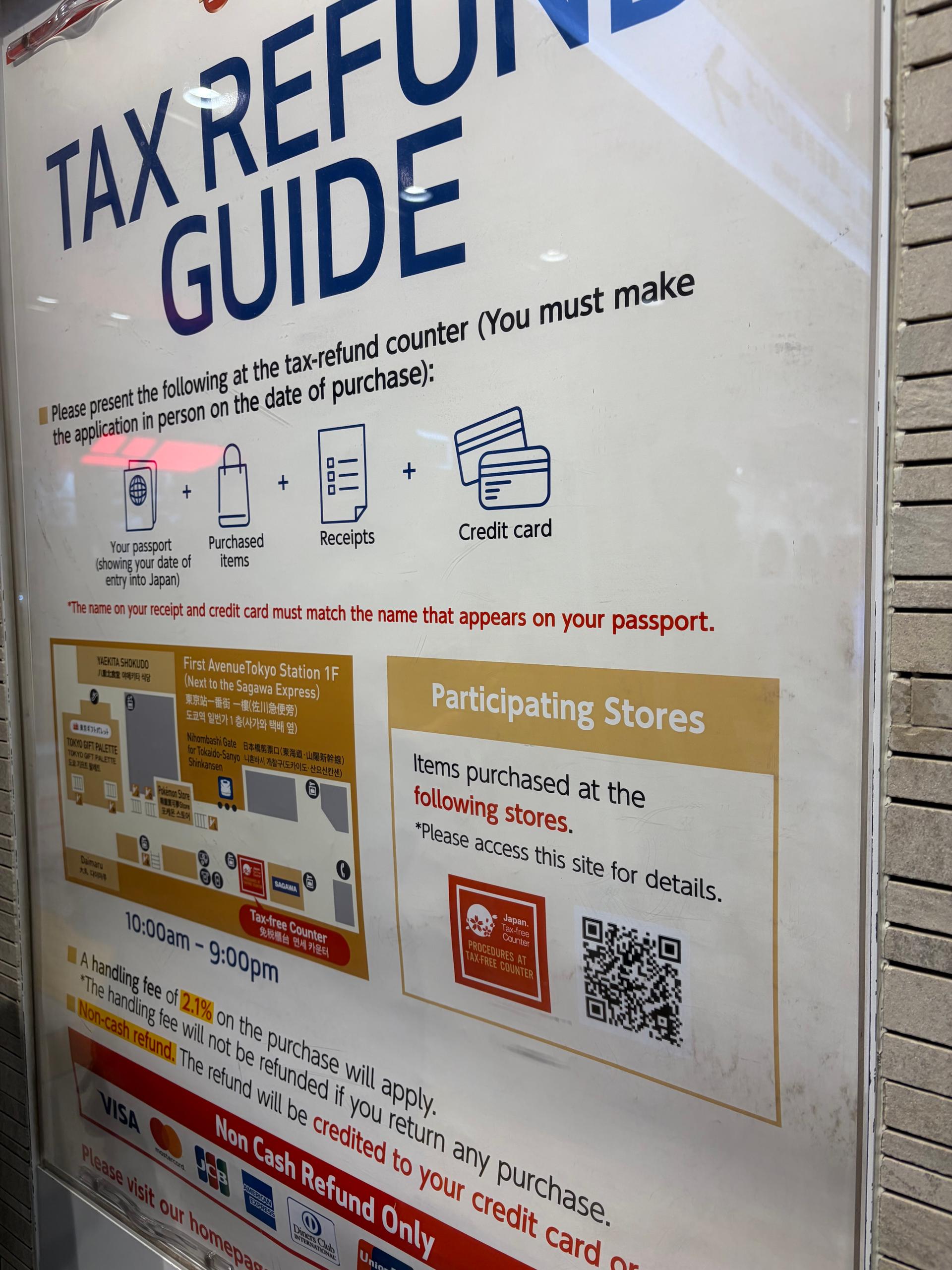
From Sunday, foreign visitors shopping in Japan will pay the full price, tax included, and only get that tax back once customs at their departure airport or port confirms the goods are leaving the country. How much of it comes back to them will depend on the shop and the refund company behind it. Some of those companies plan to take a cut.
Japan Customs says the change covers purchases made on or after 1 November and ends tax-exclusive pricing at the till. Under the new "refund method", the amount matching the consumption tax comes back only after the customs check. The standard rate is 10 per cent, and food and non-alcoholic drinks bought to take away are taxed at a reduced 8 per cent, according to the National Tax Agency (NTA).
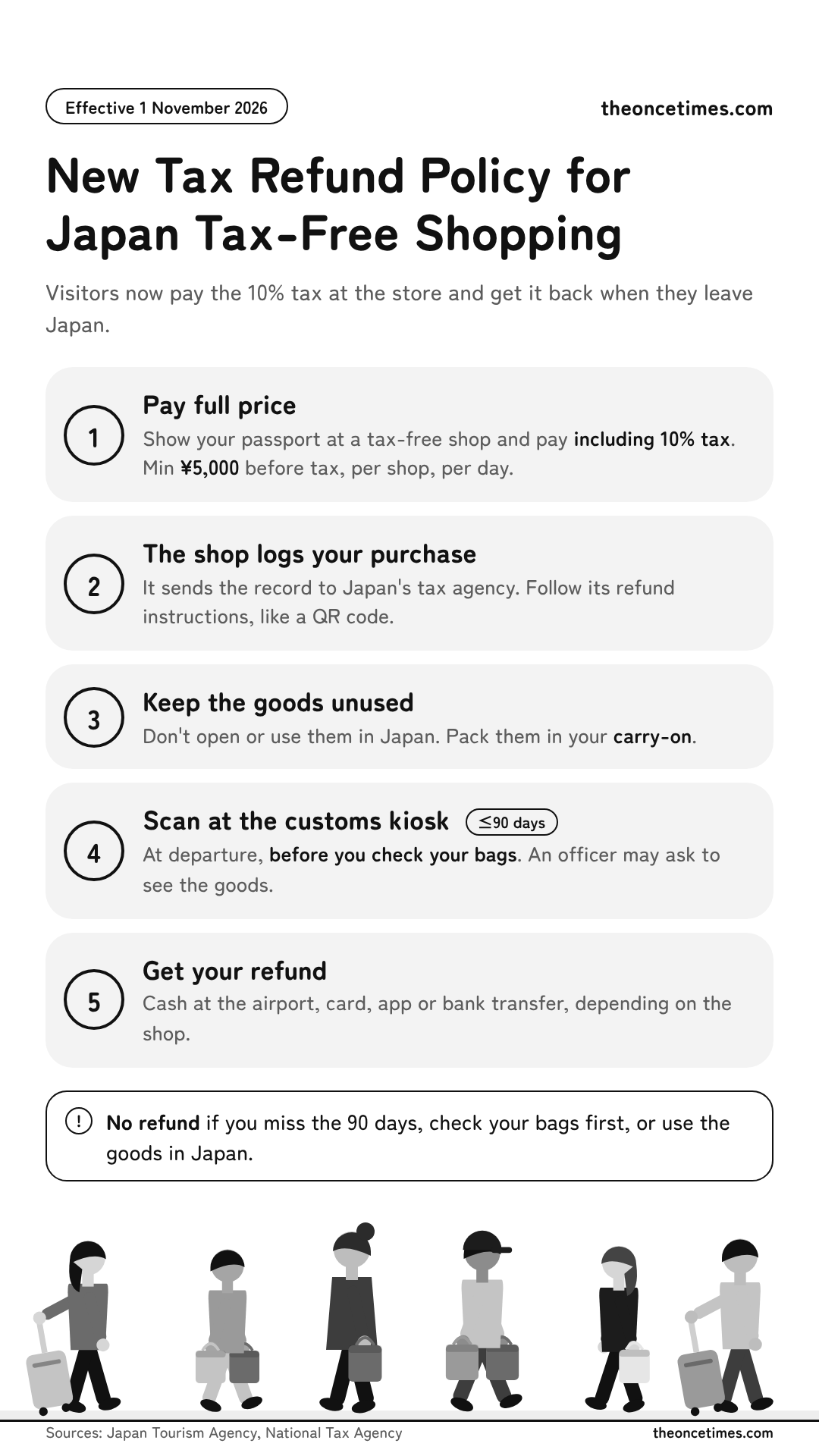
Customs confirms the export, but the refund itself is paid by each tax-free shop or a refund operator it contracts, according to the Japan Tourism Agency (JTA). Refunds are generally processed after the customs check, and travellers should ask the shop for details, the agency says. The Consumption Tax Act "does not prescribe rules on how specific refund procedures should be carried out", the NTA notes, listing bank transfers, credit card transfers, app transfers and cash at the port of departure as possible methods.
Some refund operators plan to charge travellers for the service. Global Blue already takes a service fee of about 1.55 per cent of the tax-free amount from travellers rather than from shops, Newswitch, the Nikkan Kogyo Shimbun's news site, reported in April. It would switch to deducting a fee of up to about 3 per cent when refunds are paid at departure, the report said. The report did not say what the 3 per cent is calculated on. J&J Tax Free also envisages taking its service charge out of refunds, and other operators are considering similar models, the same report said.
One big retailer says refunds at its stores will be free. Pan Pacific International Holdings (PPIH), which runs the Don Quijote discount chain, said on 5 October that refund applications at its group stores nationwide would be free of charge from 1 November, while noting that under the new system "fees may arise when applying for a refund" [translated]. Cash collected at the airport is the exception: there the refund operator's own fee still applies, the company said. It added that the offer may change or end without notice.
Cash refunds are paid only in yen, according to Newswitch. Travellers who choose a cashless refund register a bank account or credit card when they buy and are refunded after leaving Japan, the Nikkei reported. At Kansai International and Kobe airports, passengers who want cash collect it at Cash Japan terminals or counters after passing immigration; those who registered a refund destination in advance are paid later, Kansai Airports said on 19 October. Cash Japan, a wholly owned subsidiary of Global Blue TFS Japan, will offer cash refunds at six airports: Kansai, Kobe, Chubu, Fukuoka, Narita and New Chitose, Aviation Wire reported on 20 October.
Getting a refund at all is tightly controlled. The NTA, Japan Customs and the JTA say visitors must spend at least 5,000 yen, excluding tax, at the same shop on the same day. They then have to present their passport at a customs kiosk or electronic terminal when leaving Japan, within 90 days of purchase, and do it before checking in bags, because checked luggage cannot be retrieved for the check. Every item on the receipt must be carried; if even one is missing, nothing on that receipt is refunded.
Food, drink, cosmetics and other consumables used in Japan are not eligible, and travellers who have used some of their purchases must tell customs staff rather than use the kiosk, the JTA says. Anyone who leaves too little time for the procedure and misses their flight will get "no compensation from airlines or customs" [translated], the agency warns.
Some of the old limits are going. The 500,000 yen cap on tax-free purchases of consumables is abolished, along with special packaging, the NTA says. That cap applied per day to items such as cosmetics and alcohol, the Sankei Shimbun reported. In exchange, shops must report identifying details, such as brand name and model number, for any item priced at 1 million yen or more before tax as part of the purchase record they send to the NTA. Customs may ask buyers of such items for certificates of authenticity or warranties, according to the NTA and the JTA.
Customs is installing about 200 kiosks at 36 airports across Japan with international flights and at ports served by ferries, the Nikkei reported on 22 October. Twenty-two of them are at Haneda, where Tokyo Customs expects about 10,000 users a day, including those using smartphones, the newspaper said. At seven major airports, Narita, Haneda, Kansai, Chubu, Fukuoka, New Chitose and Naha, travellers can instead complete the check on their phones through the government's Visit Japan Web service, using dedicated Wi-Fi in the departure lobby, Japan Customs says.
The overhaul is aimed at resale, in which goods bought tax-free were sold on inside Japan before the buyer left, Kyodo News reported on 22 October. Of 690 departing travellers who had each bought 100 million yen or more of tax-free goods in fiscal 2022 and 2023, worth 233.2 billion yen in total, customs inspections caught only about 10 per cent, the Sankei Shimbun reported in May 2025, citing government statistics. More than 90 per cent of those caught no longer had the goods, the newspaper said. "We hope the new system will reduce fraudulent resale within Japan" [translated], a Tokyo Customs official told the Nikkei.
Shops face their own deadline. Tax-free stores that have not filed a notification on electronic provision of purchase records by 31 October will lose their tax-free permit on that date and must apply again under the new system, the NTA says. Shops that have filed are treated as licensed under the new rules without reapplying. There will be no period in which the old and new systems run side by side, according to the NTA.