Apple News
iPhone Duo owners report screen cracks; hinge link unconfirmed
Early owners of the iPhone Duo, Apple's first foldable iPhone, say the inner screen has cracked along the fold soon after purchase. Independent teardowns suggest the hinge mechanism beneath the fold may be involved, though they point to different parts, and Apple has not commented.
11 min read
By Ellis
Owners of the iPhone Duo have reported the 7.6-inch inner screen cracking along the hinge centre line within hours or days of purchase, according to MacRumors, The Verge, 9to5Mac and The National. The device went on sale in more than 70 countries and regions, including Japan, on 23 October.
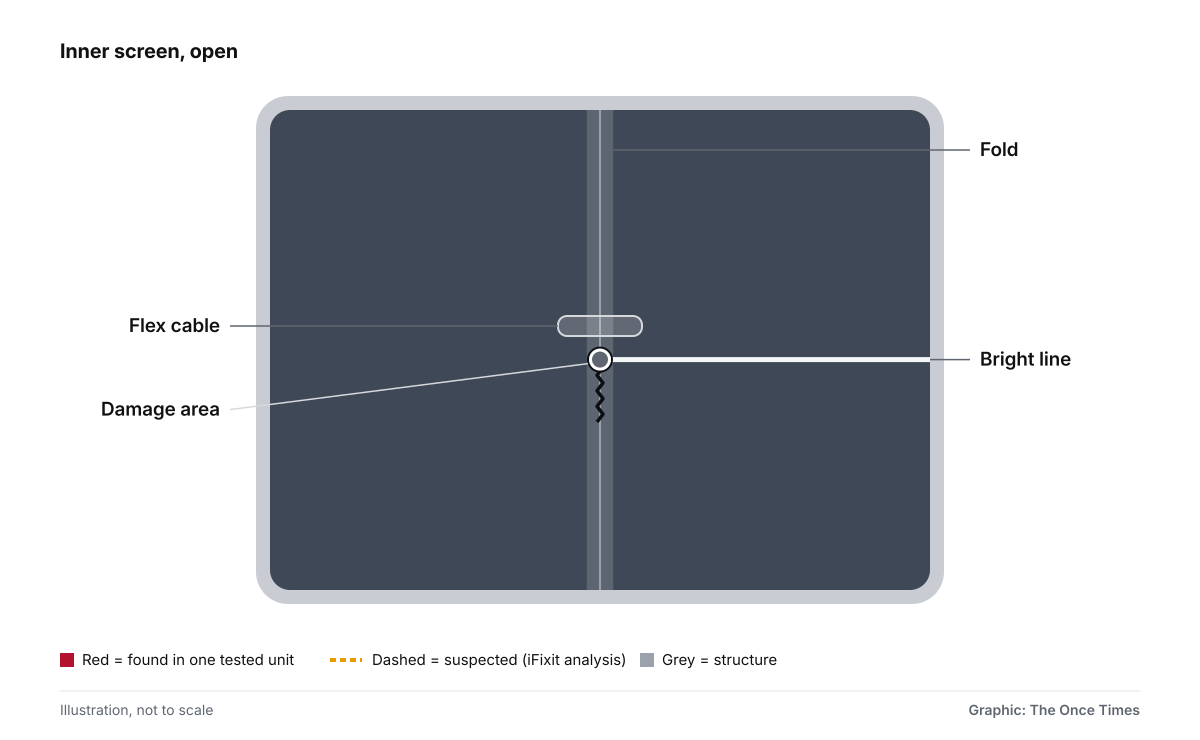
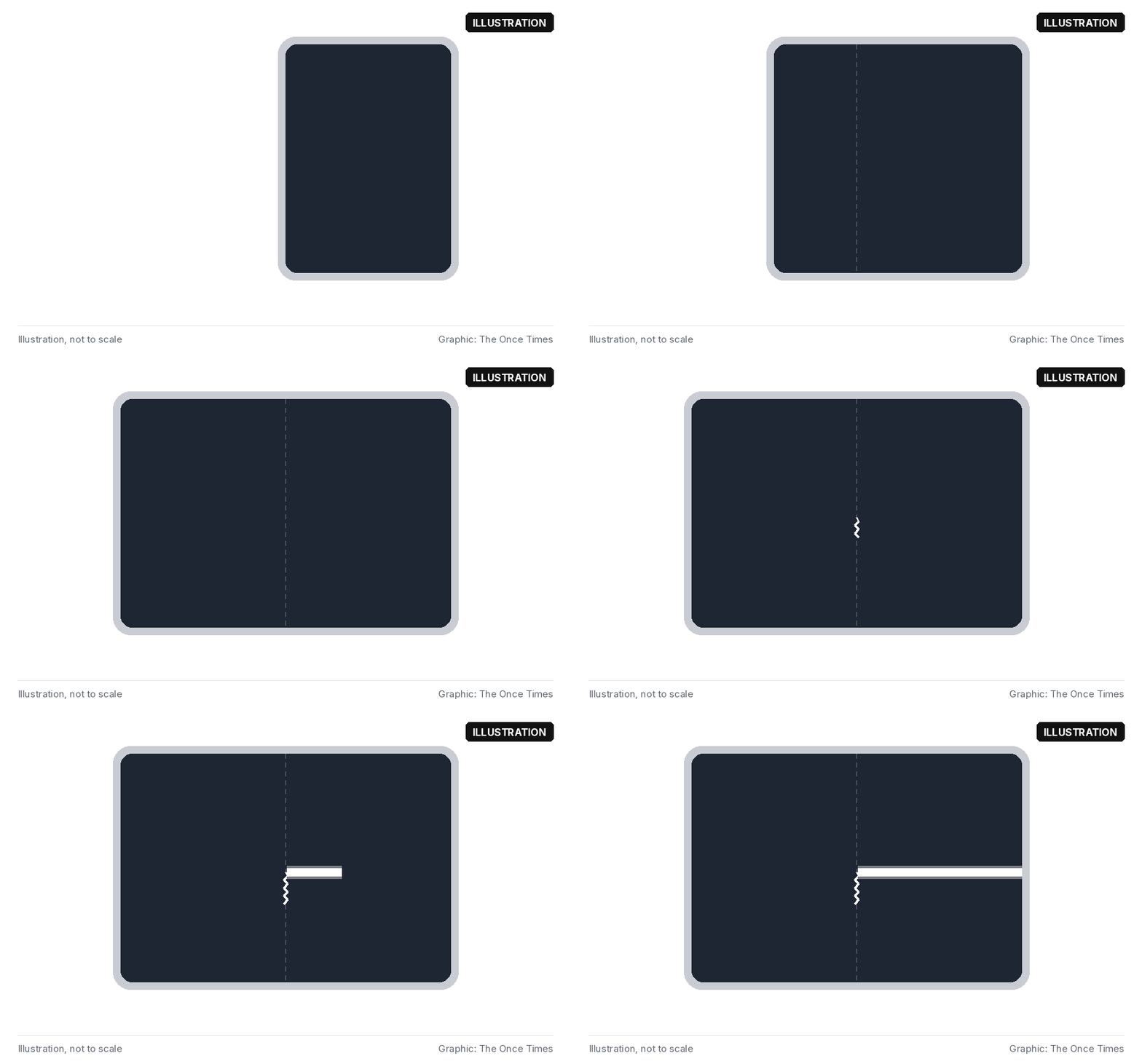
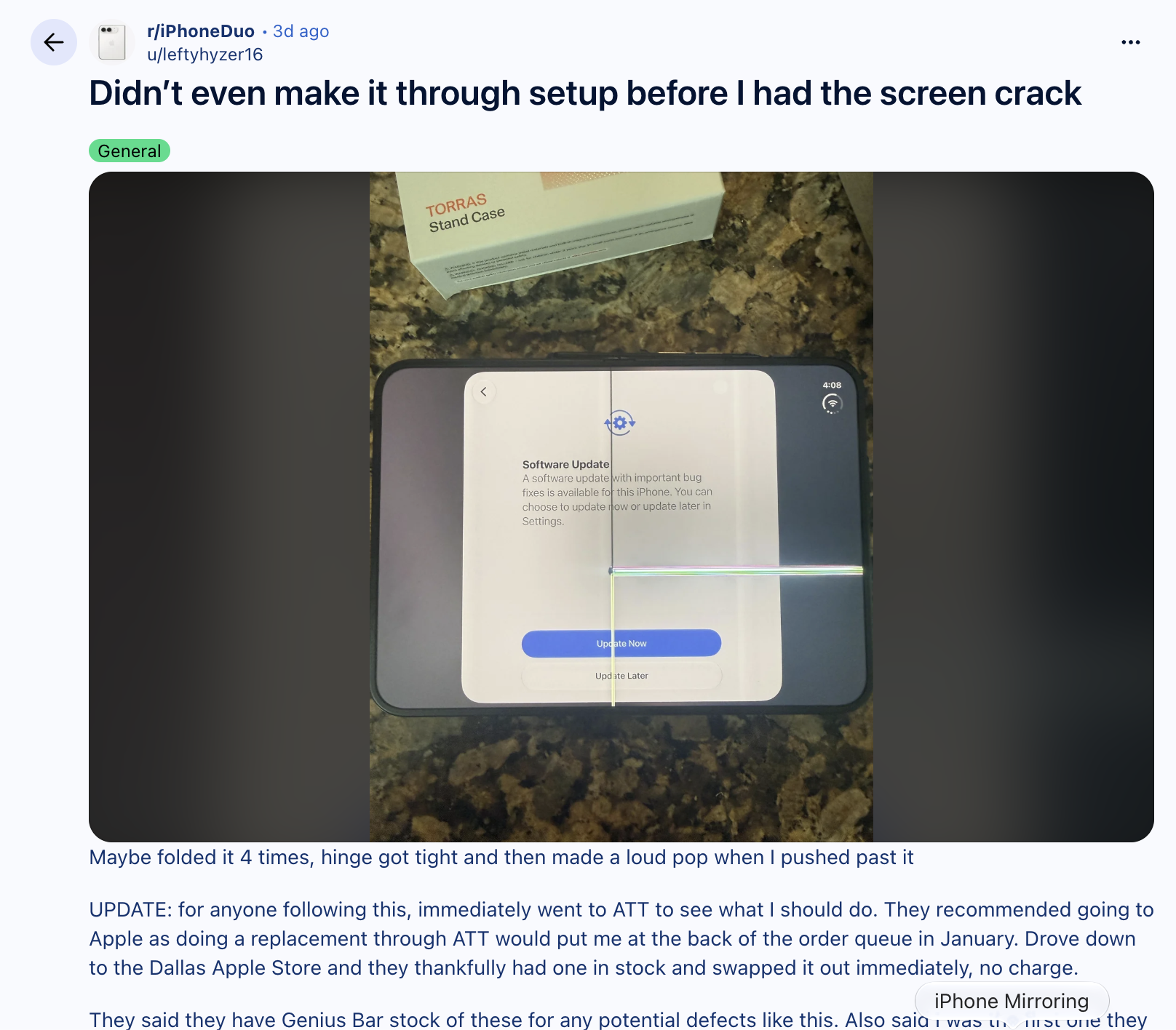
The reports describe a similar pattern: a short crack running down the fold, together with a bright or stuck-white line or block of pixels across one side of the screen, usually the right. "Almost all of the display faults are right along the hinge, and most result in a line of bright pixels across one side of the screen," Juli Clover wrote for MacRumors. Benjamin Mayo of 9to5Mac said "a couple of people even said theirs cracked during the first setup process."
Apple has not commented publicly. The Verge said Apple did not immediately reply to its request for comment, and 9to5Mac said it had asked Apple for comment and would update if it heard back. The Japanese technology site TechnoEdge reported on 26 October that Apple had not commented.
How many phones are affected is unclear. 9to5Mac said on 25 October that it had seen "about ten unique instances" and that "the scale of the issue remains unclear." AppleInsider reported on 26 October that its Genius Bar sources at seven stores had seen no cases on 24 October and one by late on Sunday 25 October, US time.
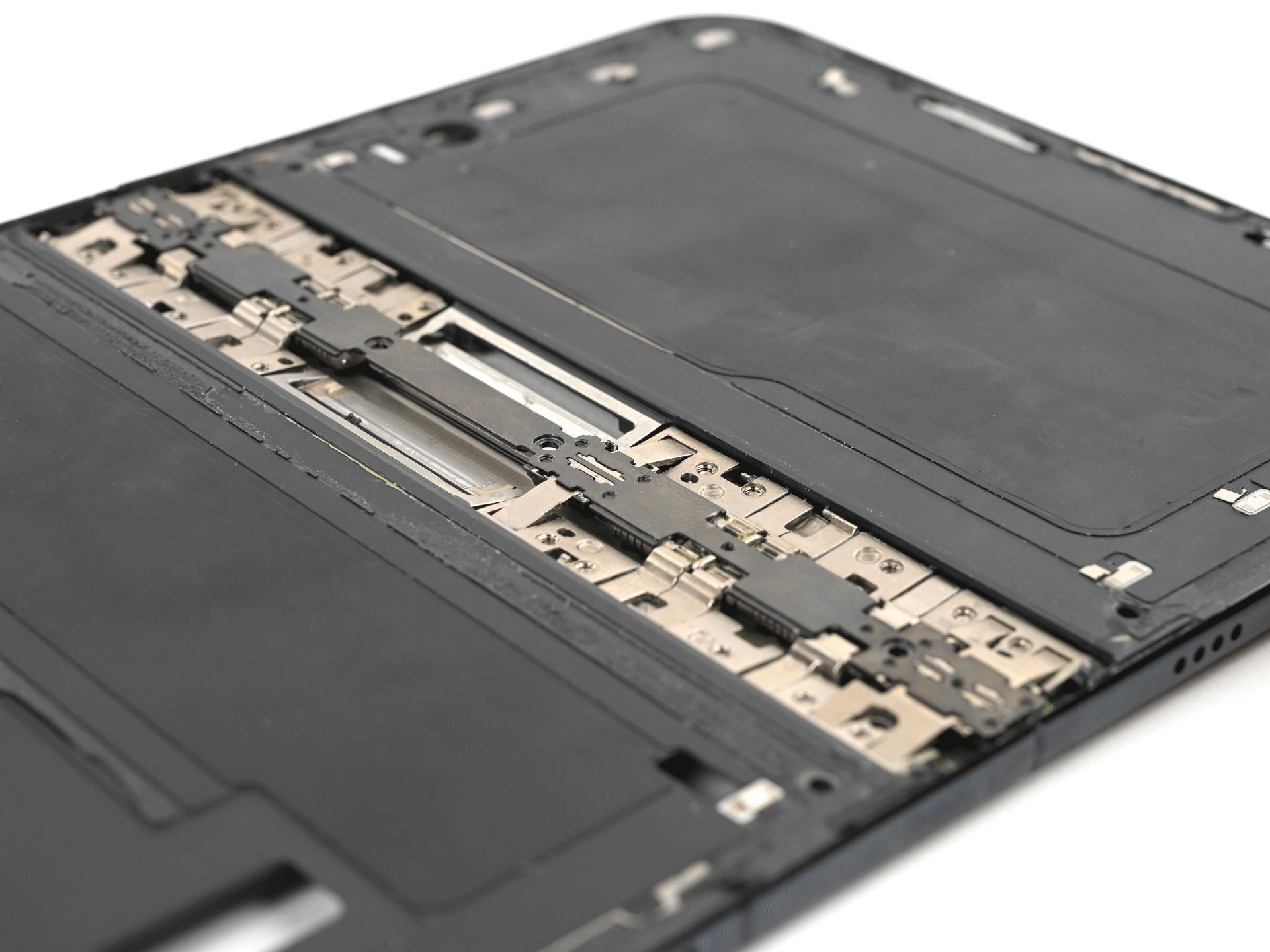
The most detailed explanation so far comes from iFixit, the repair specialist, which compared owners' photos with a 3D model of the hinge it built from teardown footage, patents and CT scans. In a teardown by Elizabeth Chamberlain, iFixit's director of sustainability, with Arthur Shi and Shahram Mokhtari, iFixit said: "The breaks cluster near the transition from the gap for the crossing flex cable to the central hinge support. The damage we're seeing in photos isn't right where the display cable passes through the hinge, but slightly lower, at a point where several edges meet and change how the thin display is supported as it bends."
"All those edges meeting in this spot mean lots of possible culprits," iFixit said. "That center pivot looks different from the rest of the hinge."
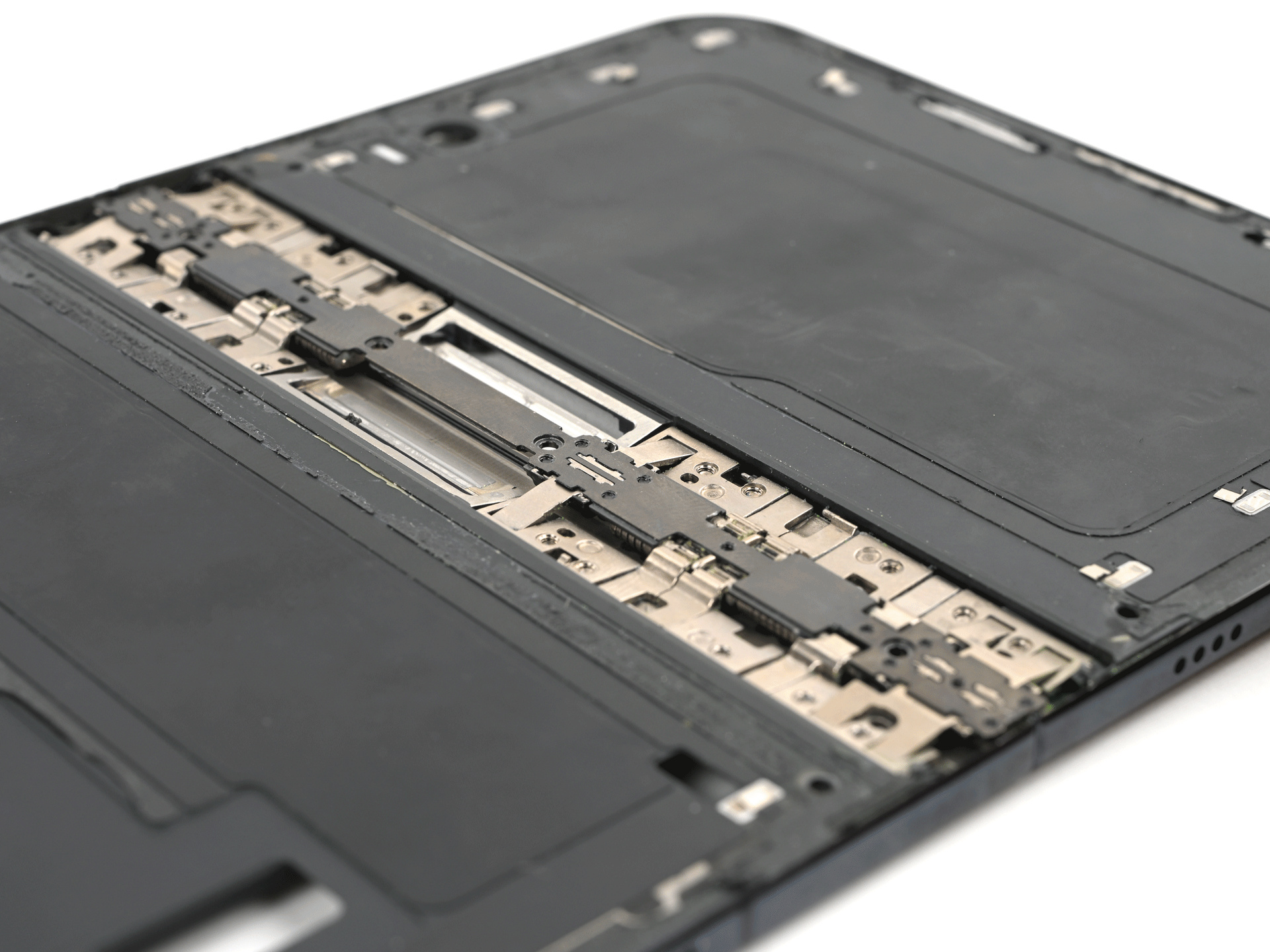
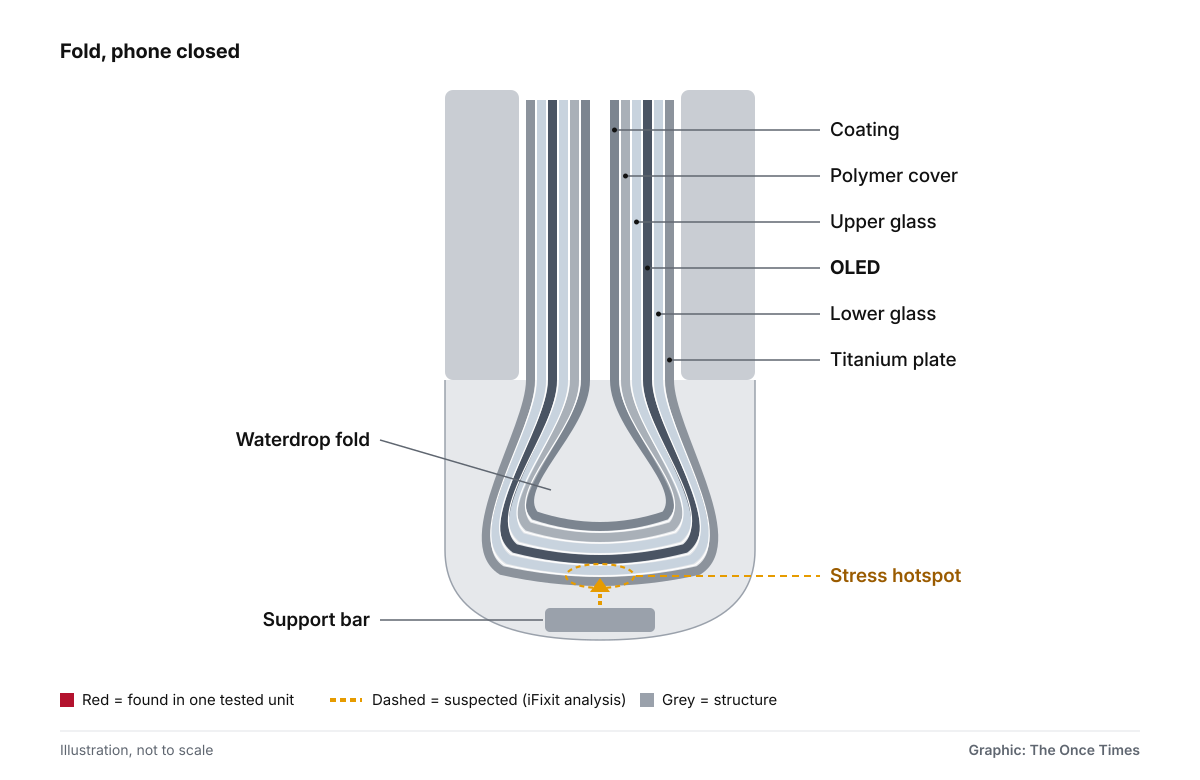
iFixit's main hypothesis involves the central support bar that runs along the hinge under the fold. "Here's one possible answer. In our closing simulation below, the center support bar fails to drop far enough. The screen's curved fold comes down onto it, creating a small stress hotspot near the reported break location," it said. The finding comes from a simulation on iFixit's own model; it did not report a support bar failing in an owner's phone.
iFixit also played down the accordion-style flex cable that links the two halves. "The cable between the halves of a foldable is always under suspicion for damage, and rightly so. But in this case, the symptoms point in another direction," it said.
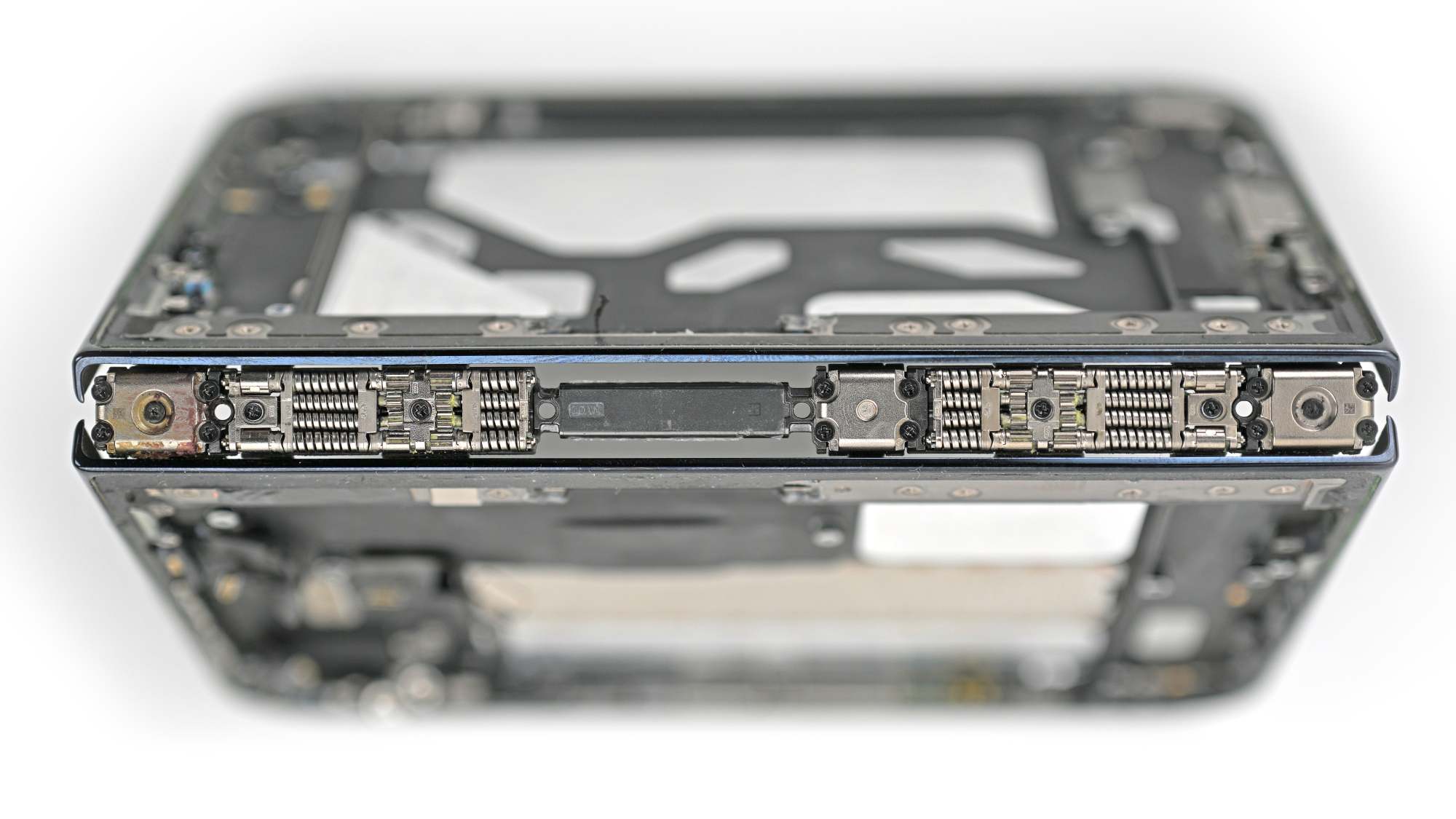
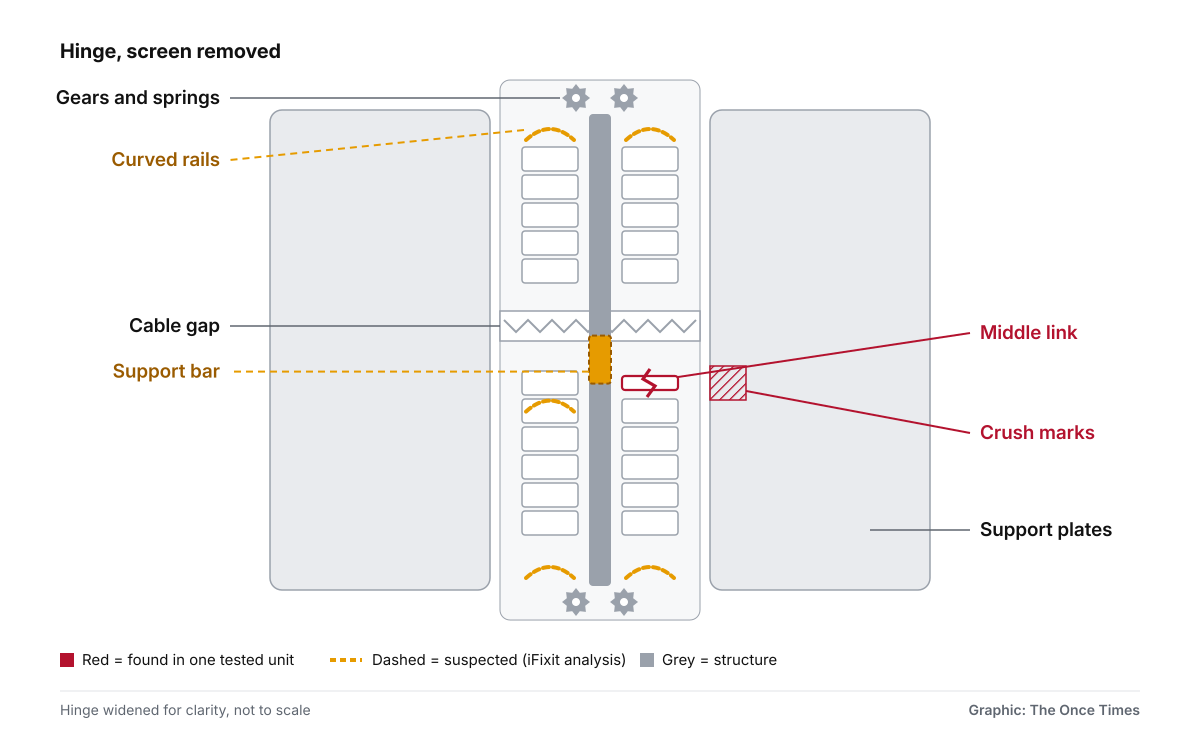
A second theory involves a different hinge part: one of the small metal links that carry the screen through the bend. The Korean YouTube channel CuriousHagi (궁금하기) took apart its own iPhone Duo after deliberately stress-testing it. "During his own testing, which involved a lot of dirt and stressing the screen by folding the hinge backwards, he tried to close the iPhone Duo, but it wouldn't shut. He then tried opening it back from its partially-closed state, only to hear a loud snap," Malcolm Owen wrote for AppleInsider.
"The piece that broke is one of the links in the middle of the phone that happens to be thinner than the links below or above it, and it snapped at a small notch where it would be weakest," Terrence O'Brien reported for The Verge. "He also found marks where the hinge met the support plate, indicating where it may have gotten caught."
AppleInsider said the channel "discovered an element that had sheared at the same location as where the screen crack originated", and that the underside of the display "also has what appear to be an impact mark, probably caused by the broken hinge element making contact." It concluded: "The most logical result is that the hinge failed to mesh correctly, the section sheared, and then hit the display, cracking it." That is AppleInsider's reading of one phone tested under conditions harsher than normal use. The channel itself placed the root cause elsewhere: in the video's English captions, the presenter says the link's snapping hit the lower display and broke it in that phone, but that "the real cause is something else", and that the dent where the hinge met the support plate looks like the result of the part failing to tuck in on one side because of that other cause.
A third theory concerns the curved rails inside the hinge. iFixit says "curved guides inside the hinge let those joints move as though their pivot points were inside the screen above them." Reporting on iFixit's teardown, Juli Clover of MacRumors wrote: "The curved rails may be lifting above the flat plates of the hinge as the phone closes, and one rail lines up with the damage. It's possible a hinge component that's meant to retract isn't doing so, but there's no clear answer." The rail theory does not appear in iFixit's written teardown or in the captions of its teardown video.
The screen itself is where the damage shows, but none of the teardowns cited here identifies the screen layers as the cause. Apple says: "High-strength glass sits above and below the folding display panel, with custom adhesives that allow the layers to glide past one another like the pages of a book, relieving bend stress, and a titanium plate at the bottom further enhances durability." Apple says a scratch-resistant coating and a nano-textured cover layer made from a custom polymer protect the surface; iFixit says that cover can be replaced while keeping the OLED panel beneath it.
iFixit said the bright line need not mean the screen layers failed first: "A localized fault in the tiny electrical connections can affect an entire row or column of pixels." The bright row and column intersect "just below where the display cable passes through the center of the hinge", it said.
Deliberate abuse tests have produced damage, but under conditions harsher than those owners describe. In a durability test by Zack Nelson of the YouTube channel JerryRigEverything, dust entered the hinge and overwhelmed the magnets that hold the phone shut, and a bend test left a permanent line across the inner display before the screen stopped responding, MacRumors reported.
Long-term folding has so far looked less punishing. Joanna Stern, writing in her newsletter New Things, said she used "a custom-built stress-testing machine that folded the phone more than 32,000 times while I slept". She put the count at 32,640 folds with "no noticeable deterioration", according to MacDailyNews and The Verge, and said: "In everyday use, it felt pretty much the same as on Day 1." MacRumors noted: "Her testing was done with a case on, and while the machine opened the Duo flat, it didn't close it all the way each time."
Apple's own hinge guidance does not settle the question. Its troubleshooting document "iPhone Duo Troubleshooting Hinge Issues" (support.apple.com/en-us/148323), published on 23 October as part of the iPhone Duo repair manual, lists five symptoms: "Device won't open or close completely", "Unexpected noise while opening or closing the device", "Loose hinge", "Bent or broken hinge" and "Enclosure damage that affects hinge operation". It notes: "There aren't diagnostics or software remedies for hinge issues."
The document tells technicians to "Remove any third-party cases or screen protectors" and to "Check for particles or dust along the hinge and for dents or scratches on the enclosure". If that fails, they are told to "replace the inner display assembly", with the warning: "Replacing a part may not resolve the device's issue." The document does not mention cracks.
9to5Mac said Apple "is widely reported to have Samsung as its key supplier" for the folding display; Apple has not named the supplier, and no report has linked any supplier to the cracks. In an interview with MrMobile's Michael Fisher, as transcribed by 9to5Mac, Rich Dinh, Apple's vice-president of hardware engineering, spoke only of "manufacturers that we work with", and JP Guillou, senior director of display technology for iPhone, said "the display doesn't exist at the vendor until we start working on it." ZDNet Korea has reported, citing unnamed industry sources, that Taiwan's Shin Zu Shing became the lead hinge supplier before launch.
The owner accounts reviewed for this report come mainly from Australia and the United States, with one each from India and Japan. One owner in Japan has described a cracked inner screen after opening the phone with force while it was in a stiff third-party case; The Once Times has found no other first-hand account from an owner in Japan. Japanese outlets, including CNET Japan, TechnoEdge, Gazlog and Netaful, have covered the issue by citing overseas cases. The Once Times has not independently verified claims on social media that devices are breaking in large numbers in Japan.
One widely cited account, quoted by The Verge, MacRumors and CNET Japan, is from a Reddit user in Australia, who wrote at 20:02 JST on 23 October: "Had my iPhone Duo for about six hours and had probably opened it fewer than 20 times. … As I continued opening it, I heard an audible crack, and the screen broke right along the hinge." According to CNET Japan, the owner said Apple's phone support offered a replacement but could not guarantee when it would arrive and required a temporary hold for the full cost of the phone, while an Apple Store replaced it with "a brand-new one on the spot", as The Verge quoted. Moderators of the Reddit forum received additional photos and Apple documents, confirmed the damage and Apple's exchange, and marked the post as a verified claim, but said they could not independently confirm the cause, CNET Japan reported on 24 October.
That owner in Japan said on X at 13:49 JST on 23 October: "受け取って設定終わって広げる時サードパーティ製のカバーが固くて思いっきり広げたら画面割れた😭" ("After receiving it and finishing setup, the third-party case was stiff, so when I opened it with full force the screen cracked") [translated]. In a later post they wondered whether the hinge was at fault, writing "ヒンジがハズレ個体だったのかなぁ?" ("maybe the hinge was a dud?"), while adding that they were probably also to blame for opening it that way [translated]. They said they had AppleCare. In a post at 18:15 JST on 24 October, they said the phone had been exchanged the previous day: "昨日の時点では修理するパーツが無いって事で商品交換になりました" ("As of yesterday there were no parts to repair it, so they exchanged the unit") [translated].
An owner in India said on X at 16:52 JST on 24 October that their phone had cracked and that they were told "Sir we don't have stock". In a later post, at 03:56 JST on 26 October, they said Apple support "just denied support stating my purchase was not from apple store", and that after the reseller replaced it: "I can confirm that the replaced device is absolutely fine!!"
The owners quoted here describe different handling by Apple and their carriers. Where a store had stock, some owners said swaps were immediate: an owner in the US said an Apple Store "had one in stock and swapped it out immediately, no charge", after their carrier said that replacing it through the carrier "would put me at the back of the order queue in January." The owner added that the store said the owner "was the first one they had seen in person today so not as widespread an issue as it seems." One owner with a higher-capacity model, also in Australia, said a replacement was harder to get: the store had no "replacement models for the 1TB and 2TB in either colour" and "can't guarantee when it will come."
One owner says Apple staff blamed a drop. The owner, who bought the phone through a carrier in the US, posted on Reddit at 04:27 JST on 25 October and said in a later update that Apple staff "inspected it and said it must have been dropped" and "suggested I add insurance to it and make a claim". They said the carrier told them a replacement "wouldn't come until months from now" and that "an exchange would have put me into January", so they returned the phone to the carrier.
In Japan, replacing the inner display costs ¥182,800 without AppleCare+ and ¥12,900 with it, according to Apple's price list as reported by ITmedia and CNET Japan, or about half the ¥364,800 starting price of the 256GB model. Apple's one-year warranty excludes accidental damage, and Apple has not said how it would classify the cracks.