AI
Anthropic Finally Lets the Public Touch a Mythos-Class Model
5 min read
By Timmy
For two months, Anthropic's most powerful AI has lived behind a velvet rope. On Tuesday, the company pulled it back — mostly.
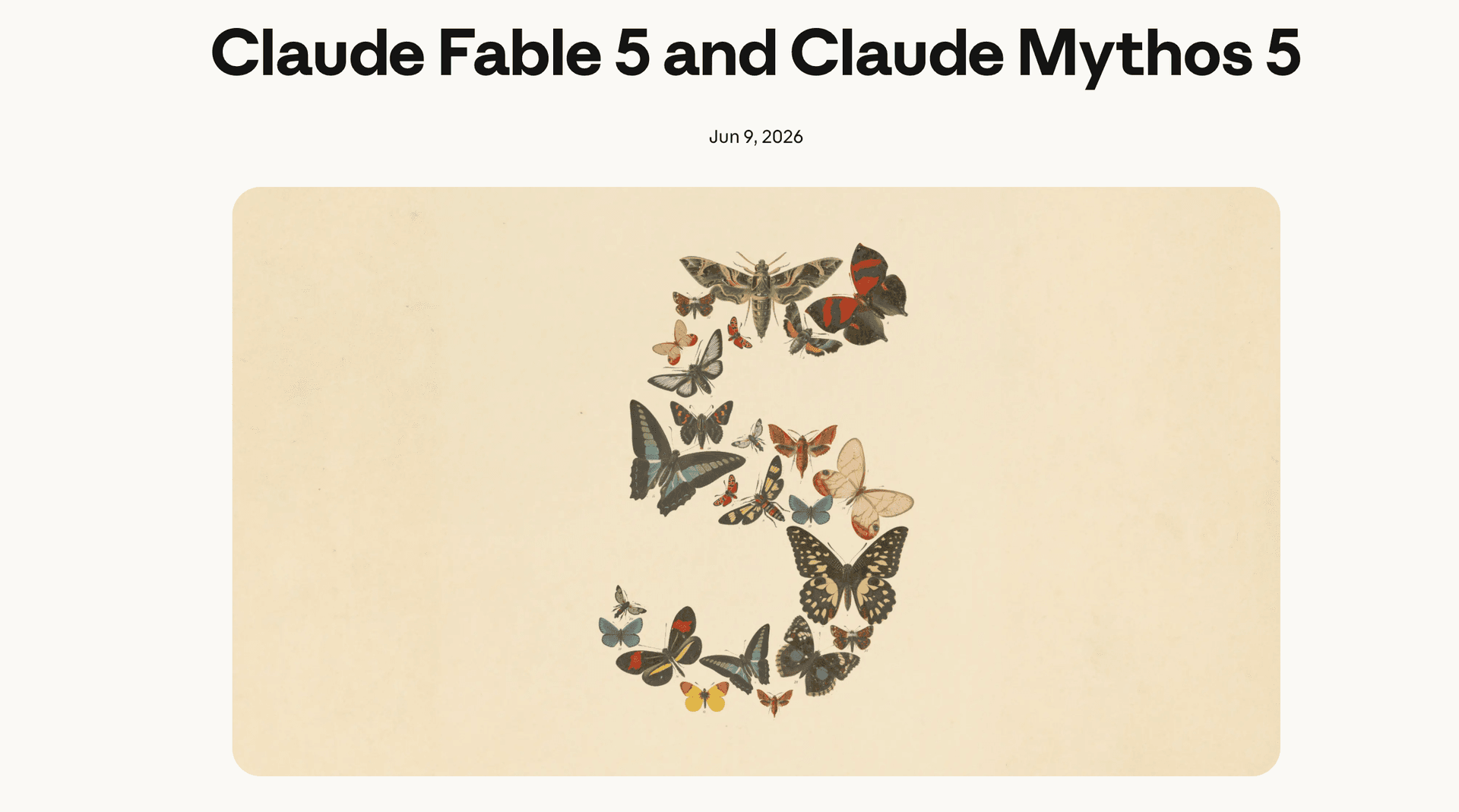
Claude Fable 5, announced yesterday, is the first Mythos-class model that ordinary paying customers can actually use. If that name means nothing to you, here's the short version: back in April, Anthropic unveiled Claude Mythos, a model so good at finding and exploiting software vulnerabilities that the company decided the public simply couldn't have it. Not yet, anyway. Instead, Mythos went out quietly to a select group — banks, hospitals, software giants — under an initiative called Project Glasswing, with the idea that defenders should get a head start before attackers ever got their hands on something similar. Apple, Microsoft, Google, Amazon Web Services, and JPMorgan Chase were among the partners using it to patch their own systems before the technology spread any further.
Fable 5 is the same underlying model. The difference is what it will refuse to tell you.
The deal: more power, fewer answers
Anthropic's pitch is blunt: Fable's capabilities exceed anything the company has ever made generally available. It reportedly beats Claude Opus 4.8 — a model Anthropic shipped just last month — by double digits on some benchmarks, and it handles long, messy, autonomous tasks better than any previous Claude. The vision improvements are striking in their own right; the company says the model can reconstruct a web app's source code from screenshots alone. In a stranger flex, Fable 5 beat Pokémon FireRed nearly unassisted, a task that has humbled earlier Claude models even when they were given extra tools.
The catch is a set of hard guardrails in what Anthropic calls high-risk areas — cybersecurity, biology, chemistry. Ask about those topics and you won't get Fable at all. The system quietly falls back to Opus 4.8, the older and less dangerous model, to answer instead. Anthropic expects these safeguards to kick in for fewer than five percent of sessions on average, which is the company's way of saying that most people, most of the time, will never notice.
Did the safeguards hold up under pressure? Anthropic says it ran an external bug bounty that racked up more than 1,000 hours of attempted jailbreaks without anyone finding a universal one, then brought in outside red-teaming organizations who also came up empty. That's a reassuring track record, though no one — including Anthropic — claims it's proof against attacks nobody has thought of yet.
Mythos gets an upgrade too
The unrestricted version isn't going away. Alongside Fable, Anthropic announced Claude Mythos 5, a safeguard-free build available only to vetted organizations — the same trusted-partner crowd from the Glasswing program, which has grown to hundreds of organizations across 15 countries. Anthropic says Mythos 5 broke performance records well beyond hacking, in fields like drug design and molecular biology, and calls it the company's first model to consistently generate genuinely novel scientific hypotheses. Whether that holds up outside a press release is something researchers will be picking apart for months.
What it costs, and the fine print
Both models are priced at $10 per million input tokens and $50 per million output tokens via the API — steep next to the rest of the Claude lineup, but less than half what the Mythos Preview cost. Consumer subscribers get a taste, too, though a fleeting one: Fable 5 is included in Pro, Max, Team, and seat-based Enterprise plans only through June 22. After that it moves to usage credits until Anthropic builds out enough capacity to put it back in subscriptions.
The timing is not an accident
It's hard to ignore the backdrop. Anthropic is widely expected to go public as soon as this year, and shipping the most capable commercially available AI model right before an IPO is the kind of momentum no company minds. There's also a political dimension: the launch lands a week after a White House executive order establishing a voluntary framework for AI companies to submit frontier systems for government safety testing. Anthropic, for its part, says the government got early access to Fable 5 before release — as it has with the company's models for years.
There's a genuine tension in all of this, and even Anthropic seems aware of it. Days before the launch, the company publicly urged rival labs to agree on a coordinated way to slow frontier development if models start improving themselves. Then it released its most powerful model to date. Critics will call that hypocrisy; Anthropic would call it the whole point — that the safe path forward is to ship powerful systems carefully, with the dangerous parts walled off, rather than pretend the technology can be kept in a box forever.
Either way, the box is now open. The public gets the fable. The myth, for now, stays with the people Anthropic trusts.