Global News
How the Electoral College Works
4 min read
By Timmy
The Electoral College is the system the United States uses to elect its president and vice president. It's a process spelled out in the Constitution. While most Americans vote on Election Day, those votes actually determine which slate of electors will cast the official ballots for the top office.
Here’s a straightforward breakdown of how the system operates.
Electors and the 270-Vote Threshold
The Electoral College is made up of 538 electors. To win the presidency, a candidate needs a simple majority of those votes, at least 270.
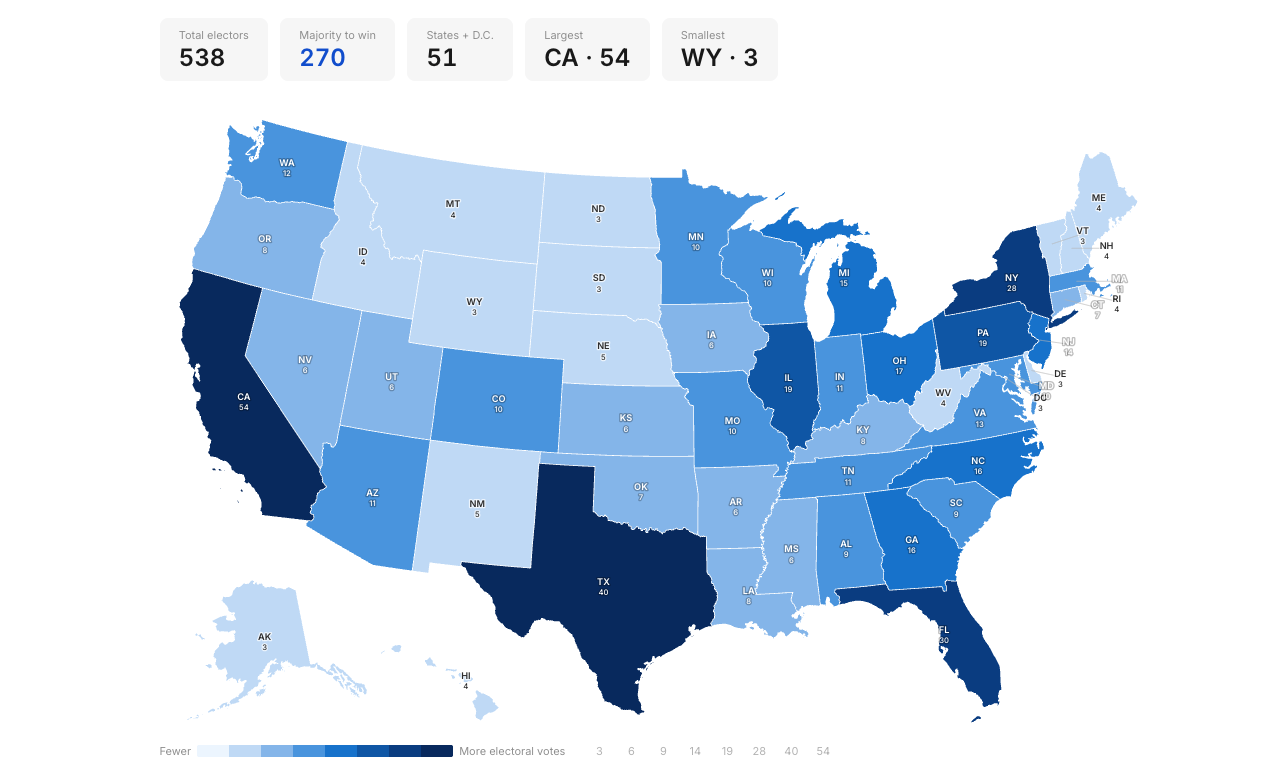
Each state gets a certain number of electors based on its representation in Congress: two senators, plus the number of U.S. Representatives it has, which depends on population. That means more populous states have more electoral votes. California, for example, currently has 54, while smaller states like Wyoming or Vermont have the minimum of three. Washington, D.C., also gets three electors, thanks to the 23rd Amendment, even though it has no voting representatives in Congress.
How the Popular Vote Translates to Electoral Votes
When you cast a ballot for president, you're actually voting for a group of electors pledged to that candidate. In 48 states and D.C., the system is "winner-take-all" that the candidate who wins the statewide popular vote receives every single electoral vote from that state. So if a candidate wins Texas by a narrow margin, they get all of Texas's electors.
The only exceptions are Maine and Nebraska, which use a different approach. They award two electoral votes to the statewide winner and one electoral vote to the winner in each congressional district. This can result in a split outcome.
From Election Day to Inauguration
The process doesn't end on Election Day. Here's what happens next:
Certification of electors: After the general election, each state's governor signs a Certificate of Ascertainment. This official document names the electors who will represent the state and is sent to the National Archives.
The electors meet: In mid-December, the electors gather in their respective state capitals to cast their official votes for president and vice president. Most states have laws binding electors to vote for the candidate they promised to support. These are known as "faithless electors," and they're rare.
Transmission and counting: The electoral votes are sent to Congress, the U.S. Archivist, the state secretary of state, and the relevant federal district court. Then, on January 6, a joint session of Congress counts the votes. The vice president presides over the count and officially announces the winner.
When the Winner Loses the Popular Vote
Because of the winner-take-all system, it's possible for a candidate to win the Electoral College while losing the national popular vote. This has happened five times in U.S. history. The most recent was in 2016, when Donald Trump won the presidency with 304 electoral votes, even though Hillary Clinton received roughly 2.9 million more total votes nationwide.
This happens because electoral votes are awarded state by state, so candidates can focus on narrowly winning key battleground states rather than running up large margins in states they're already expected to carry.
What If No One Reaches 270?
It's rare, but if no candidate secures a majority of electoral votes, the decision goes to the House of Representatives. In that scenario, each state delegation gets one vote, and they choose from the top three candidates. This has only happened twice, in 1800 and 1824.
The Electoral College remains one of the most debated features of American politics. Supporters say it protects the influence of smaller states and preserves the two-party system. Critics argue it gives outsized weight to a handful of swing states and can override the will of the national majority. But for now, it remains the rule of the game.