By Timmy
Four astronauts returned to Earth on Friday evening, closing a historic 10-day journey around the Moon that broke distance records, delivered unprecedented views of the lunar far side, and marked the first time humans have ventured beyond low-Earth orbit in more than half a century.
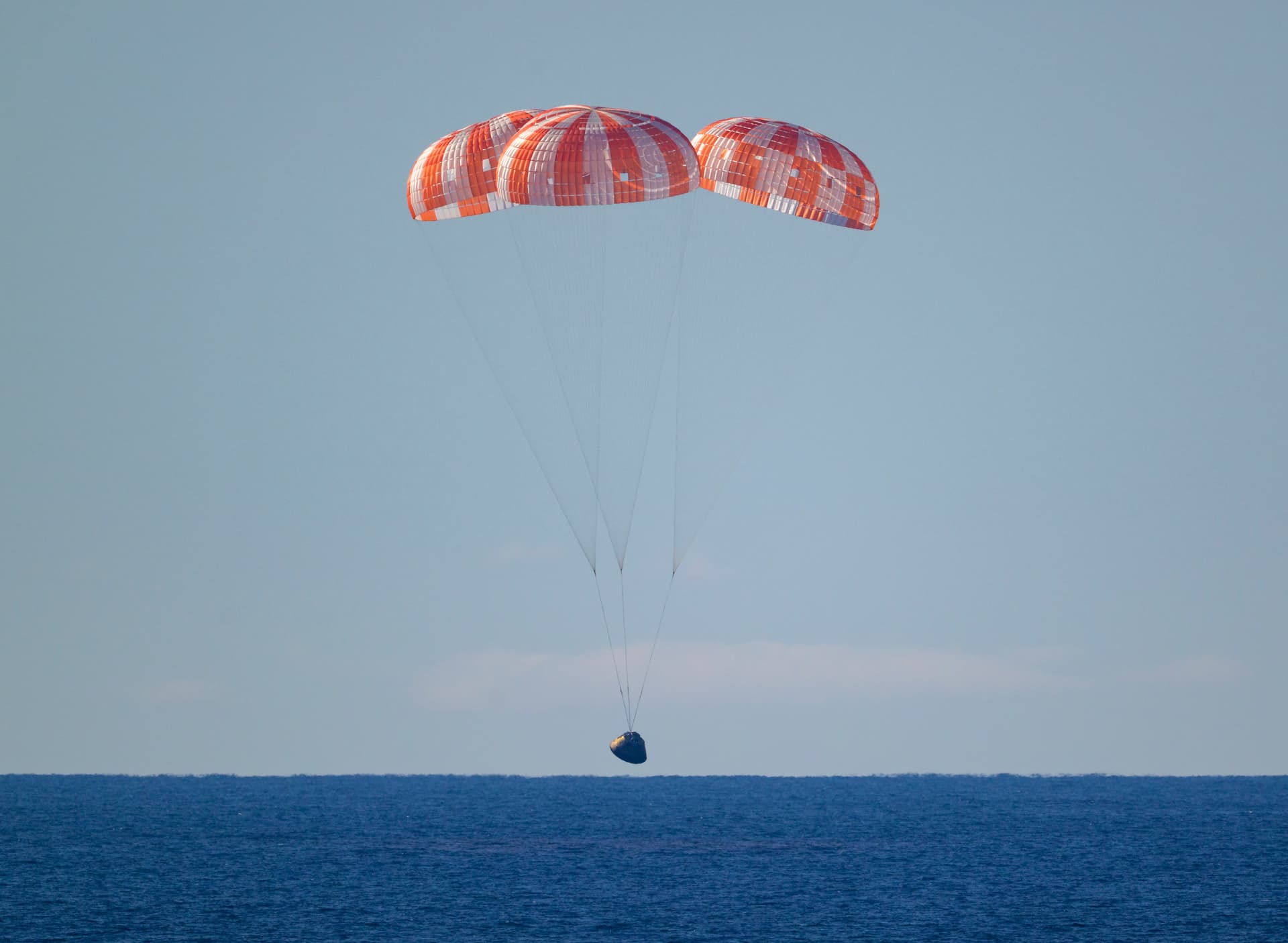
The Orion capsule named Integrity splashed down in the Pacific Ocean off the coast of San Diego at 8:07 p.m. EDT, parachuting through a clear evening sky before being plucked from the water by recovery teams aboard the USS John P. Murtha. NASA confirmed all four crew members were in good health.
"A perfect bulls-eye splashdown"
"From the pages of Jules Verne to a modern-day mission to the Moon, a new chapter of the exploration of our celestial neighbor is complete," NASA spokesperson Rob Navias said at splashdown. "Integrity's astronauts are back on Earth."
The crew — NASA astronauts Reid Wiseman, Victor Glover, and Christina Koch, and Canadian Space Agency astronaut Jeremy Hansen — launched on April 1 from Kennedy Space Center in Florida. In the ten days that followed, they traveled 695,081 miles (1,118,480 km) and reached a maximum distance of 252,760 miles (406,773 km) from Earth, surpassing the previous record set by Apollo 13 by roughly 4,100 miles.
They hit the atmosphere traveling at Mach 33 — 33 times the speed of sound — and endured a six-minute communication blackout as the capsule's heat shield bore temperatures of thousands of degrees. It was a plunge not seen since NASA's Apollo era.
Sights no human had ever seen
The mission's most striking moments came not from the technical achievement alone, but from what the crew described seeing through the capsule windows.
"We saw sights that no human has ever seen before, not even in Apollo," Commander Wiseman said. "The surprise of the day, we just came out of an eclipse where the sun, moon — the entire dark moon about that big right out the window that we were watching — we could see the corona of the sun, and then we could see the planet train line up, and Mars."
Mission specialist Christina Koch, who will become the first woman to travel to the Moon's vicinity, described the far side views as "absolutely spectacular, surreal."
"I don't know what we all expected to see," Wiseman said after the crew got their first full glimpse of Earth from deep space. "It was the most spectacular moment, and it paused all four of us in our tracks."
Jeremy Hansen, the first non-NASA astronaut to join a lunar mission, said the experience reinforced his view of humanity's purpose.
"When you see it from out here it doesn't change it — it just absolutely reaffirms that," he said. "We live on a fragile planet in the vacuum and the void of space. Our purpose as humans is to find joy in lifting each other up."
During the mission, the crew also photographed the Orientale Basin on the Moon's far side — what NASA said was the first time the entire basin had been seen with human eyes. Geologists on the mission team believe human vision can discern features that cameras cannot fully resolve.
Firsts stacked on firsts
Artemis II was layered with milestones from launch to splashdown:
First crew to lift off aboard an Orion spacecraft atop NASA's Space Launch System (SLS) rocket. The two had flown together once before, on the uncrewed Artemis I mission in 2022.
Victor Glover became the first Black person to travel to deep space.
Christina Koch became the first woman to travel to the Moon's vicinity.
Jeremy Hansen became the first Canadian astronaut to join a lunar mission.
The free-return trajectory sent the crew beyond the Moon's far side, farther from Earth than any person in history.
During the journey, the crew proposed naming a previously unnamed lunar crater after Carroll Taylor Wiseman, the commander's late wife who died of cancer in 2020.
A pathfinder for what's next
Artemis II was designed as a shakedown cruise — a test of life support, navigation, and communications systems in real flight conditions — before attempting a lunar landing. NASA has billed the Artemis program as a stepping stone toward a permanent Moon base and eventual crewed missions to Mars.
"This mission proves we can do this," lead flight director Jeff Radigan said. "We can send humans to lunar distance, keep them safe, and bring them home."
Artemis III, the planned crewed landing near the Moon's south pole, remains targeted for later in the decade. For now, NASA has a milestone to celebrate: humanity is back in deep space.